Clipela | AI Video Advertising Agency

Get In Touch
- Phone +1 (321) 213-9133
- Email sales@clipela.com
- Address 7910 4th St N Suite 10941, St. Petersburg, FL 33702, United States
- Follow us

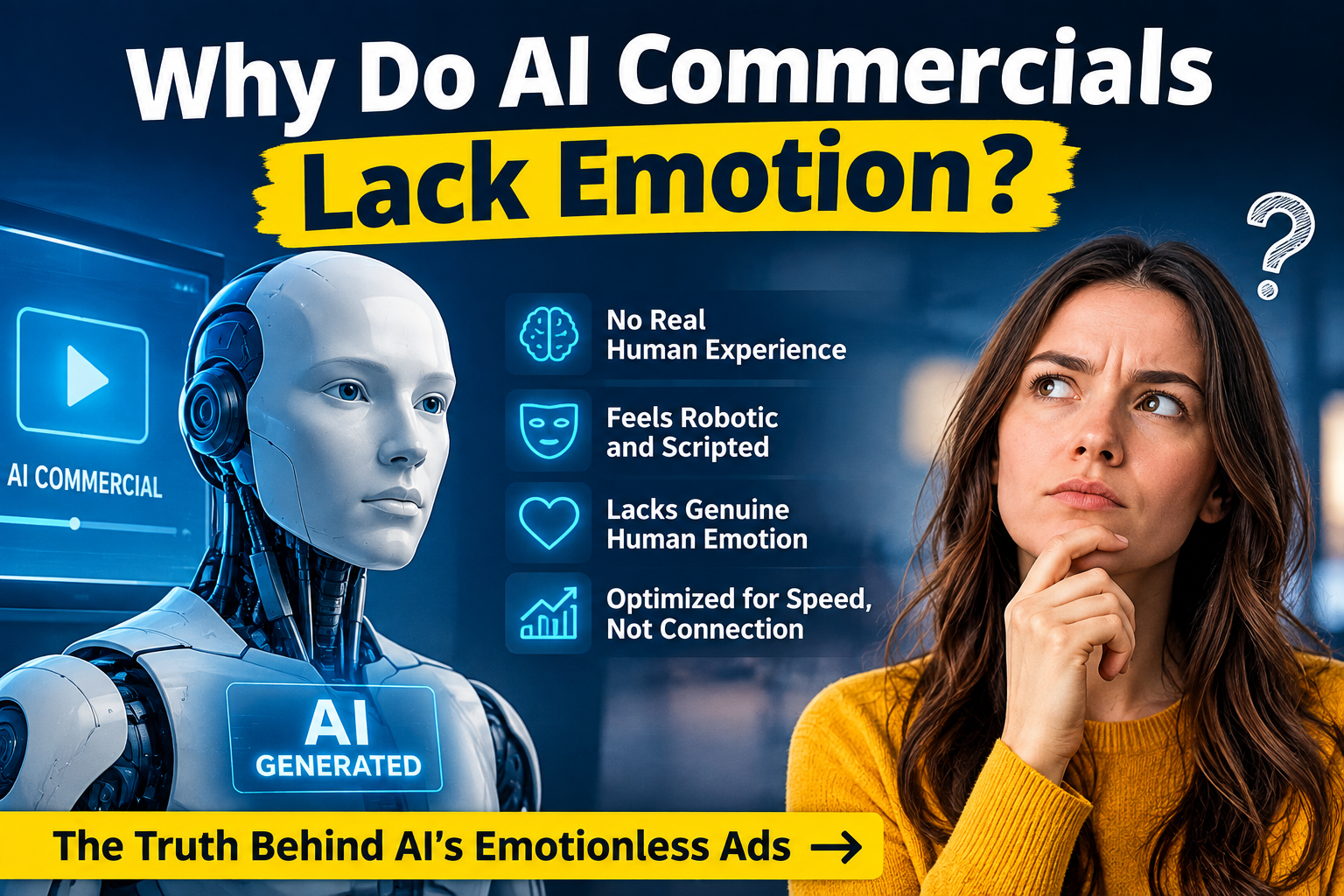
Why Do AI Commercials Lack Emotion?
We’ve sat in enough client calls this year to hear the same complaint in different words: “The ad looks great, but it doesn’t feel like anything.” That’s usually the moment someone asks us directly, ‘Why do AI commercials lack emotion, even when the footage looks like it cost six figures?’
We’ve produced enough AI-assisted commercials at Clipela to have a real answer, not just a theory. It comes down to one thing: AI can copy the shape of emotion. It can’t originate it.
The Short Answer
AI commercials lack emotion because the model isn’t feeling anything — it’s predicting what an emotional scene has typically looked like in the ads it was trained on. It can nail the crying close-up or the swelling music cue on pattern alone, but without a human deciding why that moment matters for this brand, the result plays as technically correct and emotionally empty.
What “Emotion” Actually Means in a Commercial
Ask ten creative directors what makes an ad land emotionally, and most won’t mention lighting or color grading at all. They’ll talk about the cut they held two seconds longer than felt comfortable or the line of dialogue they trimmed because saying less said more. Emotion gets built into a commercial through small, deliberate choices made before anyone presses record—what to show, what to leave out, and when to let a moment breathe instead of cutting away. That kind of judgement call is exactly where AI production tools go quiet. A model can generate a hundred versions of a scene, but it has no opinion about which one actually deserves to make the audience feel something.
5 Reasons AI Commercials Feel Flat
AI predicts patterns; it doesn’t feel anything
Every frame a generative model produces is a statistical best guess about what usually comes next, based on the ads, films, and footage it learned from. That’s genuinely powerful for speed. It’s a poor stand-in for intent, though, because the system isn’t deciding what a moment should mean to a viewer—it’s estimating what similar moments have looked like before.
The uncanny valley breaks trust before the message lands
When a generated face moves almost naturally but not quite right, people clock it instantly, even if they can’t say what’s wrong. That half-second of unease pulls attention off the story and onto the glitch, which undoes the first three seconds an ad has to earn trust.
No lived experience means no real storytelling instinct
A director who has actually sat in a hospital waiting room, said a hard goodbye, or watched a kid unwrap a first bike on Christmas morning carries that memory into a shot without trying. AI has none of that to draw on. It can describe grief or joy in convincing detail, but it has never felt either one—so scenes built entirely by prompts often read as accurate on paper and hollow on screen.
Generic prompts produce generic performances
Most AI ad output still starts from a short line of text. Short prompts get average results, because the model fills every gap with whatever is statistically most common. Skip the detailed brief, the defined character, and the specific emotional target, and AI defaults to the safest version of a scene it can produce—which is the opposite of memorable.
Speed replaces intention
The entire pitch of AI production is speed: more variations, faster turnaround, cheaper testing. That’s a real advantage, and one of the reasons brands come to an agency like ours in the first place. But when speed becomes the only goal, teams skip the slower work of actually deciding what the ad is supposed to make someone feel — and that missing step is usually the first thing a viewer notices, even if they can’t name it.
Can AI Create Emotional Commercials?
Yes — but not by itself. AI can generate a convincing cry, a warm smile, or a nostalgic soundtrack cue because it has studied thousands of ads built on those exact techniques. Where it falls short is judgement: deciding which emotion actually fits this brand, this audience, and this specific moment in the story. That call still needs a person behind it. It’s the reason the AI-produced work that actually performs almost always pairs the technology with a real creative director, rather than letting a model run unsupervised from a single prompt.
How Brands Make AI Commercials Feel Human Again
The brands getting this right treat AI as a production tool, not a creative director. In practice, that means starting from an actual brief built around one specific human truth instead of a vague theme, writing detailed prompts instead of one-liners, and having a real editor sit with every AI-generated cut before it ships. It also means testing several variations against each other rather than shipping the first pass—in our experience, the version that actually resonates is rarely the first one out of the model; it’s usually the third or fourth after someone has pushed back on tone, pacing, or a line that felt off. Teams that work this way tend to land closer to what you’ll find in our breakdown of AI video ads compared to traditional production than the generic, forgettable end of the spectrum.
What Makes an AI Commercial Feel Authentic
Authenticity in an AI commercial usually comes down to restraint, not realism. The ads that hold up tend to avoid over-polished visuals, keep camera movement natural instead of impossibly smooth, and use real audio texture instead of a flawless AI voiceover. A well-run AI video ad agency will also keep close-ups minimal in the spots where generated faces tend to slip, leaning on wider shots, pacing, and a genuinely written script to carry the moment instead. The goal was never to hide that AI was involved — it’s making sure every craft decision still feels like someone meant it.
Are AI Commercials Replacing Traditional Commercials?
Not entirely, and probably not soon. AI is taking over the parts of production that were always more mechanical—rough cuts, quick variations, professional video editing turnaround, and resizing for a dozen platforms. It isn’t replacing the strategic and creative decisions that make an ad worth remembering a week later. Most brands we work with are landing on a blend: AI for speed and volume and human direction for anything meant to build long-term brand feeling. You can see that shift playing out industry-wide in how AI video ads are reshaping marketing this year.
FAQs
Why do AI commercials lack emotion?
Because AI builds content by predicting patterns from past ads rather than drawing on real experience. It can imitate emotional cues convincingly, but there’s no actual feeling behind the choices—just a statistical best guess.
Can AI create emotional commercials?
Yes, when it’s guided by a strong creative brief and reviewed by a human editor. Left unsupervised with a short prompt, AI tends to default to generic, forgettable emotional beats.
How can brands make AI commercials more emotional?
Start with a specific human truth instead of a broad theme, write detailed prompts, test multiple variations against each other, and let a real creative director choose and refine the final cut.
Are AI commercials replacing traditional commercials?
Not fully. AI is taking over faster, cheaper production tasks like rough cuts and variations, while human direction still leads flagship, brand-building campaigns.
What role does storytelling play in AI advertising?
Storytelling is what separates a memorable AI commercial from a forgettable one. AI can generate the visuals, but pacing, timing, and narrative restraint still need human judgement behind them.
What makes an AI commercial feel authentic?
Restraint. Natural pacing, real audio texture, careful use of close-ups, and a script built around an actual insight instead of a generic prompt.
Final Thought
AI commercials don’t lack emotion because the technology is weak—they lack emotion when nobody with real creative judgment is steering it. Get the direction right, and AI becomes a faster way to make ads that still feel like they came from a person. If you’re weighing AI production for your next campaign, our work shows what that balance looks like in practice, or you can talk to our team about your brief.