Clipela | AI Video Advertising Agency

Get In Touch
- Phone +1 (321) 213-9133
- Email sales@clipela.com
- Address 7910 4th St N Suite 10941, St. Petersburg, FL 33702, United States
- Follow us

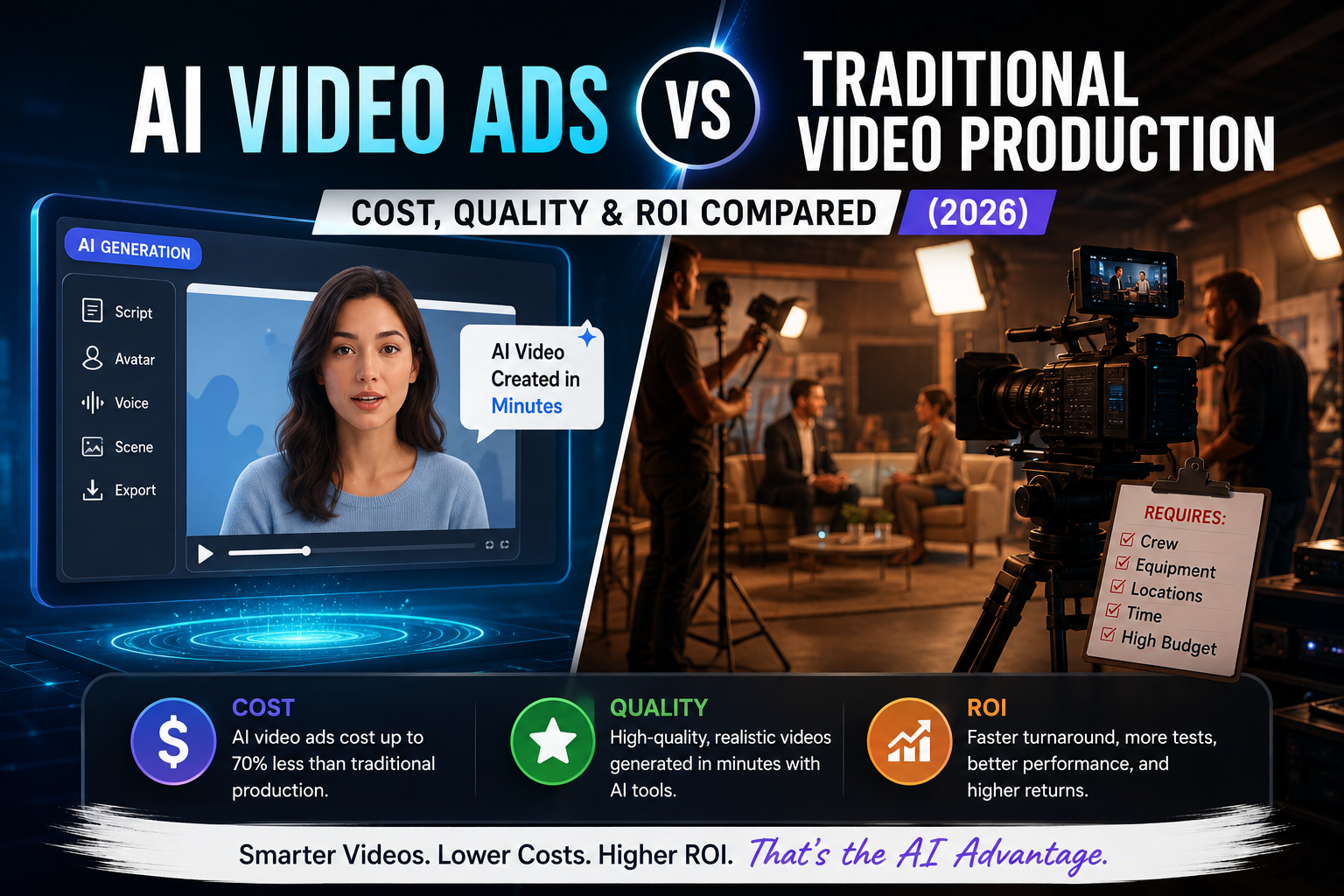
AI Video Ads vs Traditional Video Production: Cost, Quality & ROI Compared (2026)
You have a message that excites you, a launch date marked on the calendar, and a budget that needs to perform better than it did the previous year. The topic that no one discusses enough is how to actually make the video.
Do you schedule a team, choose a location, and set aside three weeks to film and edit a motion picture? Or do you use one of the AI video programs that are all over the place these days, with five iterations ready by Friday?
Ten years ago this wasn’t really a question. Today it’s one of the most debated topics in marketing, and for good reason. The way brands produce video content has quietly split into two very different paths, and picking the wrong one can cost you more than money. It can cost you momentum.
So let’s actually dig into it without the sales pitch either way.
Why This Isn’t Just a Creative Question Anymore
Video has become the price of entry for digital advertising. Whether it’s Instagram, TikTok, YouTube, or LinkedIn, audiences expect it, and platforms reward brands that keep publishing it. That’s created real pressure on marketing teams: produce more, produce faster, and don’t let quality slip while you’re at it.
Traditional video production earned its reputation the hard way, through decades of commercials, brand films, and campaigns that shaped how we think about storytelling. It’s not going anywhere. But AI-generated video ads have carved out a lane traditional production was never built for: constant, fast, affordable output.
The two aren’t really fighting for the same job. Understanding where each one actually wins is what separates a smart production budget from a wasted one.
Cost: The Number Everyone Asks About First
Traditional production costs add up in ways that surprise people who haven’t budgeted for it before. You’re not just paying a videographer for a day. You’re paying for pre-production, a director, a crew, lighting and sound gear, possibly actors, location fees, and post-production editing. A single polished commercial video can run from a few thousand dollars to well into five figures, depending on scope.
AI video production works from a different starting point entirely. Because much of the heavy lifting, editing, voiceovers, and scene generation are handled through software, the cost of producing a video drops dramatically. For a small business or a lean marketing team, that difference isn’t just a nice discount. It’s the reason they can compete in digital advertising at all against brands with ten times the budget.
But here’s the part worth sitting with: the real savings isn’t just cheaper production. It’s cheaper to experiment. When testing a new hook or message costs almost nothing, you stop betting everything on one “perfect” video and start letting performance data tell you what actually works.
Speed: The Advantage That’s Hardest to Fake
This is where the gap becomes obvious fast. A traditional production timeline, from concept to final cut, usually takes weeks. Sometimes it takes months if casting and location scheduling get complicated. That’s a fine timeline for a national brand campaign planned six months in advance. It’s a disaster if a trend is peaking right now and your competitor already has an ad live.
AI-powered video production can go from concept to finished ad in a matter of hours. For performance marketing teams running constant tests across social media advertising, that isn’t a convenience; it’s the whole game. Campaigns live or die on timing, and a three-week wait for a revised edit can mean missing the exact window when your audience was paying attention.
Quality: The Question Everyone’s Afraid to Answer Honestly
Here’s where nuance matters more than a clean verdict.
Traditional production still wins when the goal is cinematic storytelling, an emotionally rich brand film, a national TV spot, or something meant to represent a company for years. Skilled directors and experienced crews bring an intentionality to lighting, pacing, and performance that’s genuinely hard to replicate.
But quality isn’t one fixed measurement anymore. For fast-moving social content, product demos, and everyday advertising, audiences aren’t comparing you to a movie screen. They’re comparing you to the fifty other videos in their feed that scrolled by in the last ten minutes. In that world, a clean, relevant, quickly made video often connects better than an over-produced commercial that feels distant.
The honest takeaway: traditional production wins on cinematic depth and craftsmanship. AI-generated video ads win on relevance, speed, and how naturally they fit the way people actually consume content today.
Scalability: Where the Real Difference Shows Up
This is the part brands underestimate until they’re deep into a campaign. Need ten variations of the same ad for different audience segments, different languages, or different platforms? With traditional production, that means more shoot days, more editing hours, and a bigger invoice.
AI video production was practically made for this problem. Creative scalability, producing multiple tailored versions without restarting the entire process, is where AI pulls dramatically ahead. If your strategy depends on personalization, localized messaging, or rapid campaign optimization, this category alone can decide which approach makes more sense for you.
ROI: The Metric That Actually Decides the Debate
At the end of the day, nobody invests in video production for its own sake. Businesses invest in outcomes: awareness, engagement, leads, sales.
Traditional production can deliver excellent marketing ROI for flagship campaigns designed to run for a year or more, the kind of brand storytelling meant to build long-term equity. But for the daily grind of digital advertising, especially performance marketing and social-first campaigns, AI video ads tend to win on ROI simply because the cost-to-output ratio is so much stronger.
Lower spend, faster turnaround, easier testing, and the ability to adjust based on real performance data all add up to a return that traditional production, by its very nature, struggles to match at that pace.
So Which One Should You Actually Pick?
Here’s the honest answer: this stopped being an either-or decision a while ago. The brands getting the best results in 2026 aren’t choosing sides. They’re using both, deliberately.
Traditional production earns its place for the flagship moments, the campaigns meant to define who you are as a brand. AI video production earns its place in the daily work of digital advertising: the testing, the scaling, the constant content that keeps a brand visible in a crowded feed.
If you’re running a small business or a lean team without the budget for regular shoots, AI-generated video ads aren’t a compromise anymore. For most day-to-day marketing needs, they’re often the smarter first move.
Final Thoughts
Video production has changed, and there’s no real upside to pretending otherwise. Cost, speed, and scalability now matter just as much as cinematic polish, and for most everyday advertising, that shift favors AI-powered production.
The real question was never which option is objectively better. It’s which one fits the specific goal in front of you right now. Get that right, and the marketing ROI tends to take care of itself.