Clipela | AI Video Advertising Agency

Get In Touch
- Phone +1 (321) 213-9133
- Email sales@clipela.com
- Address 7910 4th St N Suite 10941, St. Petersburg, FL 33702, United States
- Follow us

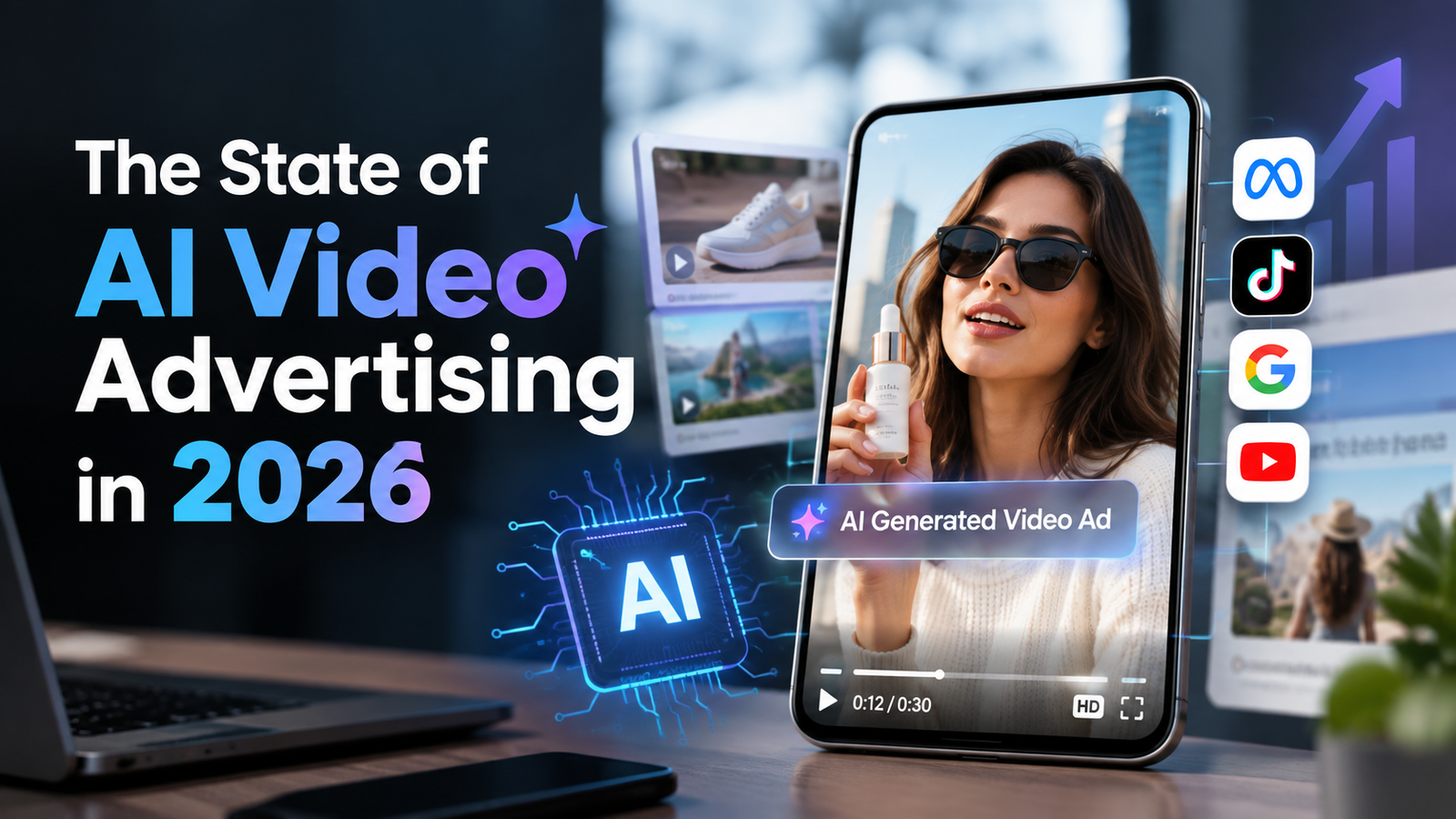
The State of AI Video Advertising in 2026
Video has been an expensive part of marketing. A crew, a studio day, many weeks in the edit bay, and a substantial budget are all necessary. The majority of performance marketers now create, test, and scale their ad creative using AI video advertising, which was previously only used by a few brands.
A traditional shoot can’t keep up with the pace of current trends. The IAB’s 2026 Digital Video Ad Spend report puts U.S. digital video spend past $80 billion this year, growing nearly 20% faster than the overall ad market, with AI-powered personalization named as one of the drivers behind that growth.
What Is AI Video Advertising?
AI video advertising uses artificial intelligence tools for scripting, visuals, voiceover, editing, and personalization to produce video ads faster and cheaper than traditional filming and post-production.
AI is part of a production process where a team uses it to speed up the mechanical stages of the work, drafting scripts, generating rough cuts, and producing variations, while a human still owns the strategy and the final edit. Most ads that actually perform in 2026 come out of the second setup. AI clears the bottleneck; a person still decides what’s worth shipping.
The Biggest AI Video Advertising Trends in 2026
A handful of shifts are shaping this year more than any single tool release.
AI-Powered Creative Production
Scriptwriting, storyboarding, rough-cut editing, voiceover, and even color grading suggestions are standard parts of the AI video pipeline now. What’s actually new is control: current-generation tools let a creator direct camera movement, pacing, and shot length instead of just accepting whatever the model spits out. That’s what’s closing the gap between “obviously AI-made” and footage that can run right next to a traditionally filmed ad without looking out of place, provided a human is still shaping the final cut.
The flip side is saturation. Feeds are full of generic AI clips that all sound the same, and audiences have gotten good at scrolling past them. Having access to AI video tools isn’t an advantage anymore; almost every advertiser does. The advantage is creative direction: a specific claim, a hook that isn’t generic, and a brand voice that doesn’t sound manufactured.
Short-Form and Vertical Video Dominate
Nothing has knocked short-form vertical video off the top spot. TikTok, Instagram Reels, and YouTube Shorts still reward fast, mobile-first storytelling that earns attention in the first few seconds, and Meta reported an 8% jump in time spent watching video on Facebook in Q1 2026 alone. AI video advertising suits this format well because it’s cheap and fast enough to produce the volume of hooks and openers that short-form testing actually requires, without reshooting each one from scratch.
Benefits of AI Video Advertising for Modern Brands
The appeal isn’t abstract. It shows up directly in the budget line and the calendar.
- Lower cost per ad. Cutting out crews, studio rental, and reshoots brings the cost of testing a new creative concept down sharply compared with a traditional shoot.
- Faster turnaround. Work that used to take weeks to shoot and edit can move from brief to finished ad in days, which matters when a trend or a seasonal window is short-lived.
- More variations, better data. Instead of betting on one polished ad, a brand can run several hooks and formats at once and let performance decide where the budget goes.
- UGC-style content without the coordination. AI-generated, creator-style video can carry the tone and trust that UGC is known for without briefing and scheduling real creators for every single campaign.
- Easier platform adaptation. One concept can be reformatted for Meta, TikTok, YouTube, and CTV specs without rebuilding the ad from the ground up each time.
Why More Brands Are Investing in AI Video Ads
Budgets are shifting toward AI video production for a simple reason: a faster testing cycle compounds. If a brand can produce ten variations for what one traditional shoot used to cost, it gets ten data points instead of one and a much clearer read on what its audience actually responds to.
E-commerce brands moved first, using AI video to test product angles and offers at a pace a traditional shoot schedule never allowed. AI video advertising lets a smaller marketing team keep up with that pace without building an in-house production department.
Challenges Businesses Still Face with AI Video Advertising
None of this comes free. Ignore these two issues, and the ad ends up being forgettable no matter how fast it was made.
Maintaining Brand Authenticity
As AI-generated footage gets harder to tell apart from real footage, the brands that keep their audience’s trust are the ones staying consistent about tone rather than chasing whatever visual style is trending that month. Authenticity has to be a deliberate creative choice now, not a side effect of having used a real camera.
Balancing AI with Human Creativity
AI is genuinely good at producing a fast first draft. It’s not good at deciding what’s actually worth saying, whether a joke lands, or when a pause needs to breathe for the emotional beat to land. Teams getting solid results treat AI as roughly the first 70% of the work: drafts, variations, rough cuts, and keeping a human creative director responsible for the last 30%, the edit, the voice, and the call on what actually goes live. Skip that step and even a technically polished AI ad tends to underperform.
How to Build High-Performing AI Video Advertising Campaigns
A workable process looks less like “type a prompt” and more like a repeatable pipeline.
- Start with a clear brief. Nail down the product, the audience, the platform, and what “success” looks like before production starts. AI amplifies a good brief; it can’t fix a vague one.
- Generate variations, not one final cut. Produce several hooks, openers, and pacing options at the draft stage. The goal here is options, not a finished product.
- Put a human on review before anything ships. Every AI-assisted draft gets edited, checked against brand tone, and polished by an actual person before it goes live.
- Format for the platform, not just the message. Meta, TikTok, YouTube, and CTV each have their own specs and unwritten pacing conventions. An ad built for one rarely runs as-is on another.
- Test small, then scale what works. Launch a handful of variants, let the data point to the strongest one or two, and put budget behind those instead of spreading spend evenly across everything you made.
How Clipela Helps Brands Create High-Performing AI Video Ads
Clipela was built around a specific gap: the space between a self-serve AI ad generator, which hands you raw output you still have to prompt, edit, and format yourself, and a finished ad that’s actually ready to run. We handle the whole process, from brief and strategy through AI-powered production to human review and platform-ready delivery.
Clipela’s work spans AI video ads for Meta, TikTok, and YouTube; AI-generated UGC-style ads; and full commercial production, AI-animated video, and platform-specific formatting for brands in e-commerce, health and wellness, real estate, professional services, and consumer products.
The Future of AI Video Advertising Beyond 2026
A few directions are already visible. Personalization is moving past dropping in a name. Agentic ad-buying standards are also taking shape. IAB reports that two in three digital video buyers are already live on, testing, or planning agentic AI for video campaigns this year, which will hand more of the real-time bidding and optimization work to AI systems while people stay focused on strategy and approvals.
Connected TV is set to keep taking share from linear TV budgets, and AI production is a big part of what makes that affordable, since one core video can be adapted across TV, social, and vertical formats instead of shot separately for each. The pattern underneath all of it: the tools keep getting faster, but the advantage stays with the brands pairing that speed with actual creative judgement.
Frequently Asked Questions
What is AI video advertising?
It’s the use of artificial intelligence tools to produce, edit, or personalize video ads, covering scriptwriting, visuals, voiceover, and platform formatting, usually paired with human creative direction.
Is AI video advertising cheaper than traditional video production?
Cutting out a full crew, studio rental, and reshoots for every concept brings down the cost of producing and testing multiple ad variations compared with a traditional shoot.
Can AI-generated video ads look like real UGC content?
Yes, when they’re guided by human creative direction rather than left fully automated.
How is an AI video ad agency different from a self-serve AI tool?
An agency like Clipela handles the entire process, strategy, AI production, human review, and platform-ready delivery, so what you receive is a finished ad, not a draft.
Ready to Scale Your Video Advertising with AI?
If your current ad creative takes weeks to produce and still doesn’t give you enough to test properly, that’s the exact problem AI video advertising solves. Clipela pairs AI-powered production with a real creative team, so every ad that reaches you has already been reviewed.
See what Clipela can build for your brand and get a video ad strategy built around your product, not a generic template.