Clipela | AI Video Advertising Agency

Get In Touch
- Phone +1 (321) 213-9133
- Email sales@clipela.com
- Address 7910 4th St N Suite 10941, St. Petersburg, FL 33702, United States
- Follow us

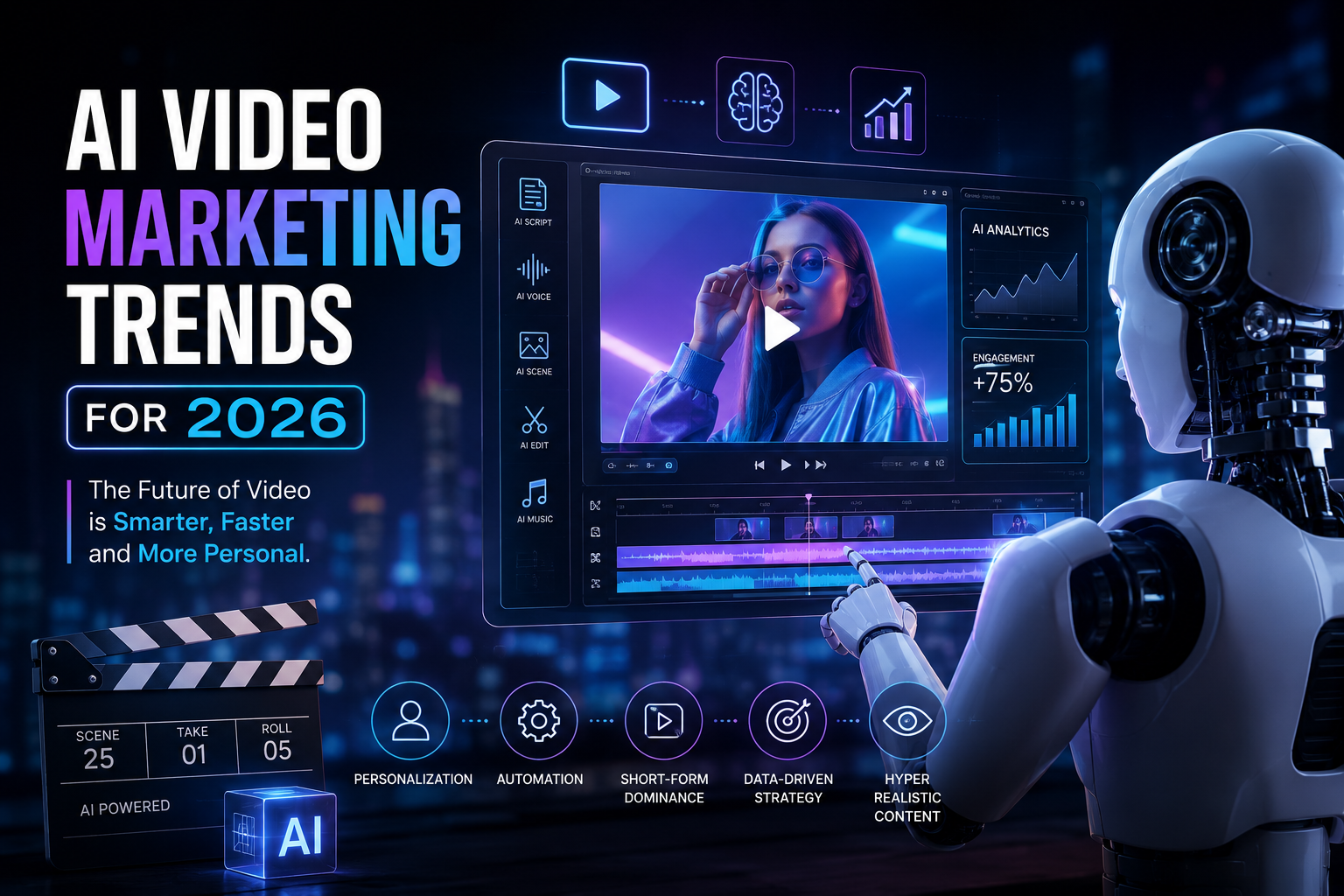
AI Video Marketing Trends for 2026
Today, marketers communicate with their consumers through video. AI is rewriting that discourse in 2026, and it is happening more quickly than most marketing teams anticipated. A five-figure budget, a week of editing, and a production crew may all be completed in an afternoon. Brands are not going through this stage. There has been a significant shift in the planning, creation, and evaluation of campaigns.
This is not something you can discreetly put off and catch up on later if you manage a company or oversee a marketing staff. It is the difference between companies who confidently scale their content and those that continue to use the same strategy from the previous year. What is really going on in the industry and what can be done about it are described below.
The State of AI Video Marketing in 2026
Over the past two years, AI video has transitioned from experimental to expected. From the initial script draft to the final export, teams who previously used it as a fun side tool now construct entire workflows around it. An increasing amount of the video material that companies provide is either entirely AI-generated or heavily relies on AI.
Generative AI has changed what video costs to make. A small business can now put out a week’s worth of product videos, ad variations, and social clips for a fraction of what a shoot used to cost. Bigger brands are using the same tools to test a dozen creative directions before spending real money on any one of them. The question in 2026 isn’t “Can we afford to make this?” It’s “Which version actually works?”
What Is Driving AI Video Marketing Growth?
A few things are pushing this forward at once, and they’re compounding each other:
Now that multimodal AI can process text, graphics, speech, and video simultaneously, a single query generates a complete scenario rather than a crude clip that requires extensive cleanup. Because social media ad expenses are always rising, marketers are compelled to test more alternatives without increasing their expenditures. Audiences expect more content, more frequently, and at a pace that no traditional production plan was designed for since attention spans are continuously decreasing. Teams may now genuinely direct a tool toward a particular brand tone rather than settling for something generic thanks to prompt engineering. And marketing automation platforms are now building video generation straight into the campaign workflow, so making the video and shipping it happen almost back to back.
Put it together and AI advertising isn’t a side experiment anymore. It’s becoming the backbone of how a lot of campaigns get built.
10 AI Video Marketing Trends Defining 2026
AI avatars are replacing traditional spokespeople. They’re showing up in explainer videos, ads, and even customer support clips, which means no more re-booking a studio every time a script changes.
Video campaigns are getting hyper-personalized. Instead of one ad for everyone, AI is spinning up different versions of the same video for different audience segments, regions, and even individual customers.
Editing at scale is genuinely fast now. Work that used to eat a whole afternoon takes minutes, with AI handling cuts, pacing, captions, and color correction with barely any manual fiddling.
Product demos are going synthetic. AI can show a product in use, across different settings, without booking a new shoot for every single variation.
Predictive analytics are steering creative decisions before launch, not just measuring them after. Teams are using data to guess which hooks and formats will convert instead of finding out the hard way once it’s live.
Multilingual content is scaling in a way it never has. AI dubbing and translation tools can rework one video into a dozen languages while keeping tone and lip sync intact—no reshoots required.
UGC-style content is being AI-assisted, not just AI-made. Brands are blending real creator footage with AI editing to get something that feels authentic but still moves at production speed.
Shoppable video is merging with AI production. Interactive ads let people browse and buy without ever leaving the video itself.
Iteration cycles are shrinking. Instead of one big campaign launch, brands are running a steady stream of smaller tests and adjusting the creative weekly based on what’s actually performing.
And, maybe most importantly, humans are still steering the ship. The real shift isn’t AI replacing creative teams — it’s creative teams using AI as a production layer while keeping strategy, storytelling, and brand voice firmly in human hands.
Industries Benefiting Most
Some industries are ahead of others here. E-commerce brands use AI product videos to show items from every angle without a new photoshoot for each SKU. SaaS companies lean on AI for onboarding and explainer content that needs constant updating as the product changes. Real estate and hospitality brands are turning out virtual walkthroughs at a fraction of what they used to cost. And local service businesses are finally able to run advertising that looks professional without a professional price tag.
Challenges Businesses Should Consider
None of this comes free of friction. Audiences are getting better at spotting generic, templated AI output, and content that feels hollow tends to burn trust faster than it builds it. Brand consistency gets harder to hold onto when videos are being churned out at speed across five platforms at once. There are also real, unresolved questions around originality and disclosure — where does AI assistance end and AI replacement of genuine creative work begin? Businesses that treat AI as a shortcut instead of a tool tend to see it in their engagement numbers first, and not in a good way.
How Businesses Can Prepare
The brands actually getting ROI from AI video aren’t the ones chasing every new tool that drops. They’re the ones with a repeatable workflow: creative strategy first, AI doing the heavy lifting second, a human reviewing everything before it goes live. That means real time spent on prompt engineering, brand guidelines the AI is actually trained to follow, and close enough tracking of performance to know what’s working versus what just looks impressive in a demo reel.
How Clipela Helps Brands Scale AI Video Marketing
At Clipela, we help brands turn these trends into results instead of guesswork. Our team pairs AI video tools with real creative strategy, building AI-generated videos and AI commercial productions that sound like your brand — not a template. From AI product videos to full AI video campaigns, we manage the entire production workflow so you get content that scales without losing the human touch your customers actually respond to.
If you’re ready to move past one-off experiments and build a video marketing strategy for where this industry is actually heading, get in touch with our team. We’ll show you how AI-powered video production can work for your brand in 2026 and beyond.