Clipela | AI Video Advertising Agency

Get In Touch
- Phone +1 (321) 213-9133
- Email sales@clipela.com
- Address 7910 4th St N Suite 10941, St. Petersburg, FL 33702, United States
- Follow us

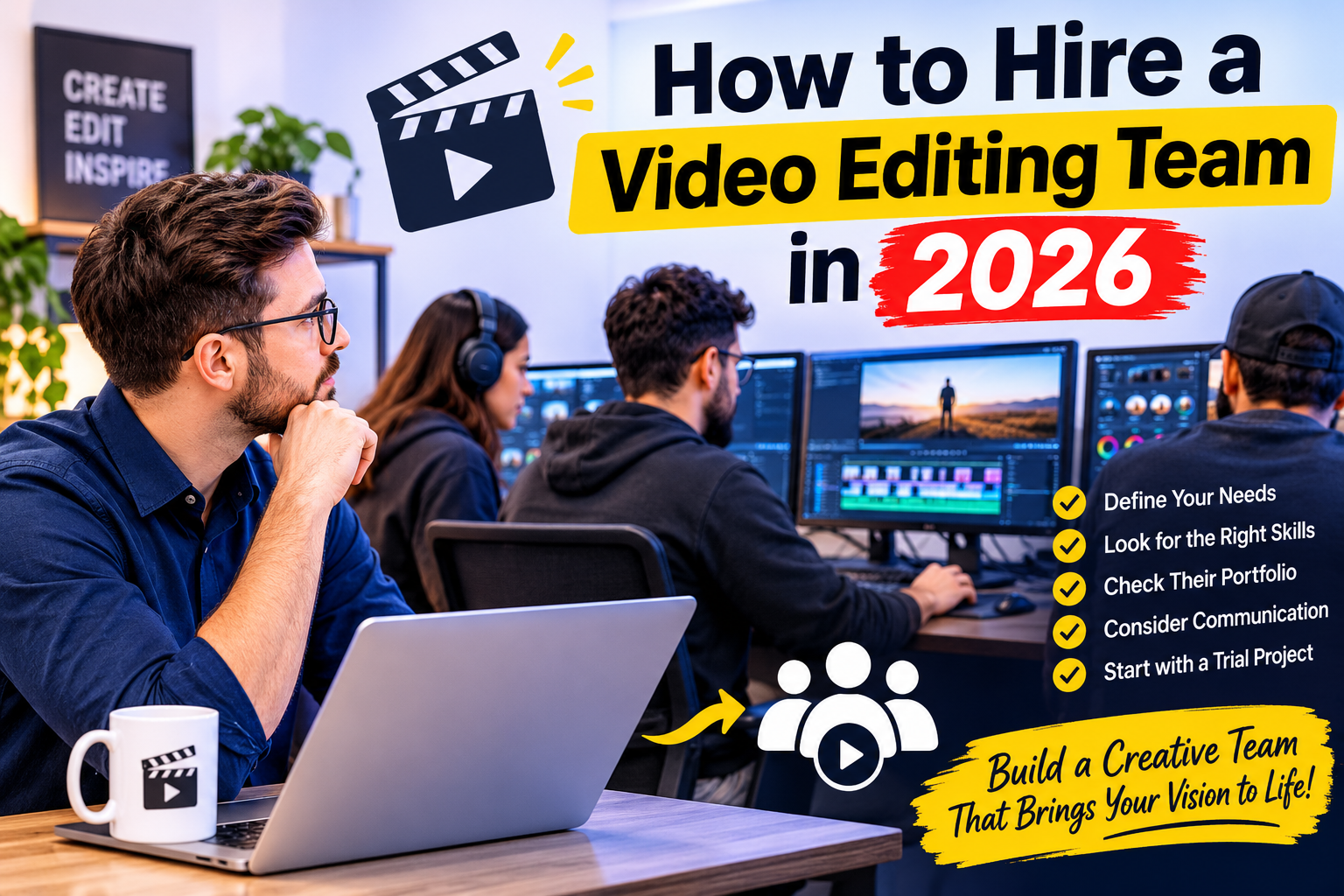
How to Hire a Video Editing Team in 2026
A competent team does not only work to trim footage.It analyzes your brand, follows your creative direction, fulfills deadlines, is open to changes, and keeps up quality even as your workload grows.
The ideal way to hire a video editing crew in 2026 is to compare five elements side by side: production capacity, workflow, portfolio quality, relevant experience, and total cost. You are guided through each one by this guide.
Do You Need a Video Editor or a Full Team?
Start with your workload, not your wishlist.
A video editing team makes more sense once your output grows. You likely need one if you:
- Publish several videos a week
- Need both short-form and long-form contents
- Run video ads across more than one platform
- Need multiple creative versions of the same video
- Manage more than one brand or campaign
- Sit on large amounts of raw footage
- Need motion graphics or heavier post-production
- Juggle overlapping deadlines
- Want someone else to run the editing workflow, not just the cutting
A team also gives you something a single editor can’t: backup. A larger video production team usually has someone ready to step in. That matters when video is tied to an active campaign with a launch date.
What to Look for in a Video Editing Team
Look at whether it can do the specific work you need.
Relevant experience. An editor who specializes in cinematic brand films may not be the right fit for fast-turnaround performance ads. Look for the work that matches your format, industry, and platform.
Storytelling and pacing. A skilled editor knows what to cut, where to shorten a scene, and how to keep a viewer watching. Short-form work needs a strong hook and fast visual changes. Long-form work needs tension, no dead space, and a clear sense of where the story is headed.
Platform knowledge. A video built for YouTube rarely works as-is on TikTok or Instagram Reels. Your team should understand aspect ratios, safe areas, captions, pacing, and how to build separate versions for separate placements.
Creative support. A strong video editing team should understand a creative brief, not just follow a shot list. It should ask smart questions when the brief is unclear and suggest fixes when something isn’t working.
Communication. Before you sign anything, find out who manages your project, where feedback gets shared, and how fast the team typically responds. Slow communication is one of the most common reasons video projects stall.
Check Their Portfolio Carefully
A portfolio shows what a team has made. It doesn’t automatically prove what they can make for you.
Start with projects that match your needs. Need YouTube videos? Look at their long-form work. Need social content? Review their short-form editing. Need paid ads? Look at actual ad examples, not just cinematic brand films.
While you watch, pay attention to pacing, story structure, audio quality, captions, color grading, motion graphics, b-roll, and overall polish.
For ads, watch the first few seconds closely. Is the message clear right away? Does the visual change at the right moment? For YouTube, pay attention to the opening and how the editor moves between sections.
The best portfolio isn’t the flashiest one. It’s the one that shows the team can solve the exact editing problem you have.
Check Their Production Capacity
This is where hiring a video editor and hiring a video editing team really differ. A team can produce excellent work and still struggle if it doesn’t have the capacity to match your schedule.
Before you commit, ask:
- How many editors are available for your account?
- How many projects can they run at once?
- How many videos can they deliver each week?
- Who manages the work day to day?
- Is there a backup editor if someone is out?
- Can they scale up during a campaign?
- Can the same team handle both short- and long-form content?
Editing two YouTube videos a month is a very different job from producing several YouTube videos, dozens of short clips, and multiple ad variations every month. A capable team should be able to explain, clearly, how its workflow changes as volume increases.
Ask for a Paid Test Project
A small paid test shows you how a team actually works, not just how they talk about working. Give them a short piece of real footage and a clear brief that includes your audience, platform, target length, brand guidelines, reference videos, key message, and deadline.
Then judge more than the finished video. Did they understand the brief? Was the pacing right? Did they make smart creative calls? Was the audio clean? Did they follow your brand style? How did they handle your feedback?
Keep the test small and fair. Never ask a candidate to complete a large project for free — that’s a red flag in the other direction, too.
Ask These Questions Before Hiring
Before you hire a video editing team, ask:
- Who will actually work on my videos?
- How many editors are available?
- What types of videos do you specialize in?
- What’s your normal turnaround time?
- How many revisions are included?
- How do you collect and manage feedback?
- Who manages the project?
- Can you handle recurring monthly video editing?
- Can you match our existing brand style?
- Do you provide motion graphics and sound design?
- Can you build different versions for different platforms?
- How do you organize raw footage?
- Will I own the project files?
- What happens if my assigned editor is unavailable?
- Can your team scale if our volume increases?
The answers tell you far more than any sales pitch.
How Much Does a Video Editing Team Cost in 2026?
There’s no single price for video editing services. Cost depends on the scope and complexity of the work.
| Pricing model | Works well for |
| Per project | One-time videos |
| Per video | Repeatable content |
| Hourly | Flexible or unpredictable work |
| Monthly retainer | Ongoing content production |
| Dedicated team | High-volume production |
Final cost shifts based on video length, number of videos, amount of raw footage, motion graphics, animation, sound design, color grading, number of revisions, turnaround time, and how many platform versions you need.
A simple social clip and a polished commercial shouldn’t cost the same, and they usually don’t. When you compare quotes, compare the full scope, not just the number at the bottom. One proposal may include project management, multiple editors, and quality control. Another may cover basic cuts only.
If you need ongoing work, ask about monthly video editing or a retainer. A recurring arrangement usually makes sense once you know roughly how much content you need each month.
Freelancer vs. Video Editing Team vs. Agency
| Option | Best fit | Main benefit | Watch out for |
| Freelancer | Occasional projects | Flexible, low commitment | Limited capacity |
| In-house editor | Steady internal workload | Deep brand familiarity | Higher long-term cost |
| Video editing team | Consistent content volume | Greater capacity | Needs a clear workflow |
| Video editing agency | Managed, full-service production | Editing plus strategy support | Usually a bigger investment |
A freelancer works well for simple, low-volume projects. A video editing team makes sense once several projects need to move at the same time. A full video editing agency fits when you want help beyond the cut itself, such as creative direction or campaign strategy. Match the model to your actual workload, not the other way around.
How the Video Editing Workflow Should Work
A professional workflow is clear before production even starts.
1. Creative brief. Define the audience, message, platform, style, length, deadline, and deliverables up front.
2. Asset collection. Send raw footage, logos, brand guidelines, scripts, music, voiceovers, and reference videos. Organized assets speed up everything downstream.
3. Creative direction. Before editing starts, the team should know what the viewer should think, feel, or do after watching — especially for ads.
4. First cut. The editor builds the first version, focused on structure, pacing, and the core message.
5. Review and feedback. Give specific notes. “Hold the product shot at 0:32 for another second” works far better than “make it more exciting.” Specific feedback means fewer revision rounds.
6. Revisions. The team applies the agreed changes. Your contract should state exactly how many rounds are included.
7. Quality control. Someone checks spelling, captions, audio, visual glitches, branding, timing, and export settings before delivery.
8. Final delivery. The video is exported in the formats you need. For larger campaigns, that often means multiple aspect ratios, lengths, and hooks.
Should Your Video Editing Team Use AI?
AI-assisted tools can help with transcription, captions, rough cuts, background cleanup, voice tools, and repurposing footage into new versions.
The real question isn’t whether a team uses AI. It’s how they use it. The best workflow pairs AI-assisted production with human creative direction, editing, and quality control — especially for brands producing large volumes of video or testing several creative concepts at once.
Clipela works this way: AI tools speed up the early production steps, while our editors review, refine, and finish every asset before it’s delivered.
Red Flags When Hiring a Video Editing Team
Be cautious if a team:
- Can’t show portfolio examples relevant to your work
- Makes unrealistic delivery promises
- Has vague or unclear pricing
- Can’t explain its revision policy
- Won’t tell you who will actually handle the project
- Communicates slowly or inconsistently
- Has no real feedback process
- Can’t explain how project files are managed
- Has no backup plan for an unavailable editor
- Leans on flashy effects but can’t explain the story
- Struggles to follow a basic creative brief
Extremely low pricing isn’t automatically a problem, but find out exactly what’s included before you compare it against another quote.
How to Choose the Right Team
Start with three questions:
What are you producing? YouTube videos, social clips, paid ads, product videos, or a mix?
How much are you producing? One video a month needs a different setup than twenty.
How much do you want to manage yourself? If you want to handle every detail, a freelancer may be enough. If you want a team to manage editing, revisions, and delivery, look for a managed video editing team or agency.
Then compare options on relevant work, capacity, workflow, communication, turnaround, revisions, and total scope. Don’t judge on price alone.
Final Checklist Before You Hire
- Reviewed relevant portfolio examples
- Confirmed who will work on your project
- Checked production capacity
- Discussed turnaround time
- Confirmed pricing and deliverables
- Defined the revision process
- Established a feedback process
- Shared your brand guidelines
- Confirmed platform requirements
- Discussed monthly production needs
- Considered a paid test
- Confirmed project-file ownership
- Discussed backup coverage
- Agreed on the full workflow
Finding someone who is proficient with Premiere Pro or DaVinci Resolve is not the goal of hiring a video editing team. You are selecting a co-producer. The ideal one should simplify your content creation process rather than add to your already burdensome workload.
Frequently Asked Questions
How much does it cost to hire a video editing team?
Cost varies based on video length, volume, complexity, motion graphics, revisions, and turnaround time.
Is it better to hire a video editor or an agency?
It depends on your workload. A freelancer suits occasional editing. A team or agency offers more capacity and broader production support for ongoing content.
What should I provide to a video editing team?
A creative brief, brand guidelines, scripts, logos, music or audio references, raw footage, your target platform, desired length, style examples, and a deadline.
Can a video editing team handle multiple videos each month?
Yes, this is one of the main reasons businesses choose a team over a single editor. Confirm capacity, workflow, turnaround time, and backup coverage before signing on.
Should I hire a team for YouTube and social media videos?
If you’re producing both regularly, yes. YouTube and short-form social content need different pacing, structure, and formatting, so confirm the team has real experience with both.